Life in Toulon, Le Var
 Tomas k - Senior News Editor

When I told family and friends that I was moving to France, few were surprised. Having been a solo traveler for over a decade, my flight-happy habits had become an occupational hazard. The idea of moving abroad had been festering in my soul since the first trip I took in 2014. In my early twenties, the object of desire was Spain. Later on, I entertained London, and then Lisbon. Ultimately, a trip to the Aeolian Islands followed by a precious week along the Côte d’Azur sealed the deal. If I didn’t make the move soon, I would regret not giving myself the opportunity. Whenever I need to make a decision in life, I picture myself as a one hundred-year-old lady on her deathbed. Does that version of me want to be able to say I had lived abroad, or that I had continuously chickened out over the course of decades, never doing the decisive thing? My answer always becomes obvious. (But how I picture myself at one hundred years old needs some work.)
Although my loved ones embraced the decision I had made, the answer to the next question stumped everyone. “Where will you go?” they asked. First, a month in Toulon, followed by the big move to Paris. Choosing Toulon was really an excuse to spend the shoulder month of September squeezing out the last drops of the lemon that is summer along the Mediterranean. “Where’s Toulon?” they asked, tripping over the pronunciation, no worse than I did.
Toulon is Marseille’s little sister. The sibling that never gets the limelight, always in the shadows. My American family and friends have no reason to know about Toulon, where it is, or why I’d want to spend my first month living in France there. If you’ve seen the 2012 film adaptation of Les Misérables, then you might know that the first scene takes place in Toulon. You know the one. 24601, Look down, a miraculous feat of strength, freedom. You recall the godforsaken port that served as the Bagne of Toulon from 1748 to 1873, where imprisoned men like Jean Valjean served their sentences? That’s where I was headed!
Although I’m a lifelong enthusiast of Les Misérables, its first scene is not why I decided to move there. In fact, it wasn’t until after I had been in Toulon for three weeks that I learned about its role in French history. I picked Toulon for a very different, very specific reason: It’s a well-connected small port town with access to Hyères, Île de Porquerolles, and the villages of Provence. At first, it was less about Toulon itself and more about the other places I could easily visit. Soon enough, though, Toulon would become my home in its own right.
The Beaches

Growing up at the beach in New Jersey, I prefer the coast to the city. Later in Paris, I learned this the hard way when I started booking weekend city breaks to places like Normandy just to touch sand and get out of the metro. Toulon has sand, and it’s the kind I like. Along its manageably walkable coastline, from Plage de Pipady in the west to Plage de l’Anse de Magaud in the east, families, friends, and parties of one like me joyfully bask under the Provençal sun, knowing that Toulon will never know the crowds of Nice, Cannes, or Saint-Tropez. The water sparkles, the air smells of juniper, and the breeze (or the Mistral if it’s off-season) blows in the fronds of the ubiquitous palm trees. Bring a market picnic to Plage de la Mitre and swim under the rocher de la patte d’éléphant (elephant foot’s rock). Walk along the Quai Belle Rive that connects la Mitre to the beaches of Mourillon, taking in the views across the mouth of the Rade de Toulon. Keep walking to the Mourillon district, noticeably posher than the rest of Toulon, sections of which can feel quite brusque. Here, the sand is met with a winding row of beach shack cafes, each one just as viable an option for a salty air apéro as the last. Windsurfers flow into the water armed with gear as children giggle at the sight of volleyball matches. Toulon’s beaches are an apt representation of its pathos as a port town. Take it from someone who grew up at the Jersey Shore: being under the radar is a good thing. Access can be granted, but the cat will never go back into the bag once it’s out. So, perhaps it’s best to summarize the beaches of Toulon as “just alright.” Don’t go out of your way.
The Markets

I’d be lying if I said open-air markets weren’t a top-five reason for spending a month in Provence. An addiction to markets formed early in my solo travel days and has only metastasized since. On any given summer day, I can be spotted in a small French seaside village skipping all the way to the market with my trusty string bags and hope. In Toulon, two markets pop up almost daily: one in Mourillon on Boulevard Bazeilles and one in the old part of town on Cours Lafayette. Although it’s hard to pick a favorite child, I’ll whisper to you that the smaller market in Mourillon has my heart. I will always prefer the more out-of-the-way choice, and the Mourillon Market is my pick. In the summer, stone fruit and melons look radiant under yellow and orange awnings and become irresistible beach picnic snacks. After gathering your bounty, head down Rue Lamalgue towards the beach, jump on a bus towards Hyères, or catch the early ferry to Île de Porquerolles.
Recently, Toulon signed a new lease on life thanks to the renovation and reopening of Les Halles, the closed market anchored in the old town. Closed for almost twenty years, it’s now part of the Biltoki group of markets found across France. Home to a wine bar I’ve frequented more times than I’ll share with you, arancini, pinchos, sushi, Polynesian food, raclette, oysters, and anything else you could want from a food hall, Les Halles has become the epicenter of Toulon’s lunchtime and nightlife. A rooftop bar completes the attraction, and cafes that fall along the perimeter of the building have joined in on the late night fun. Having spent evenings here solo and in good company, it’s an easy plan to make over and over again.
The Port

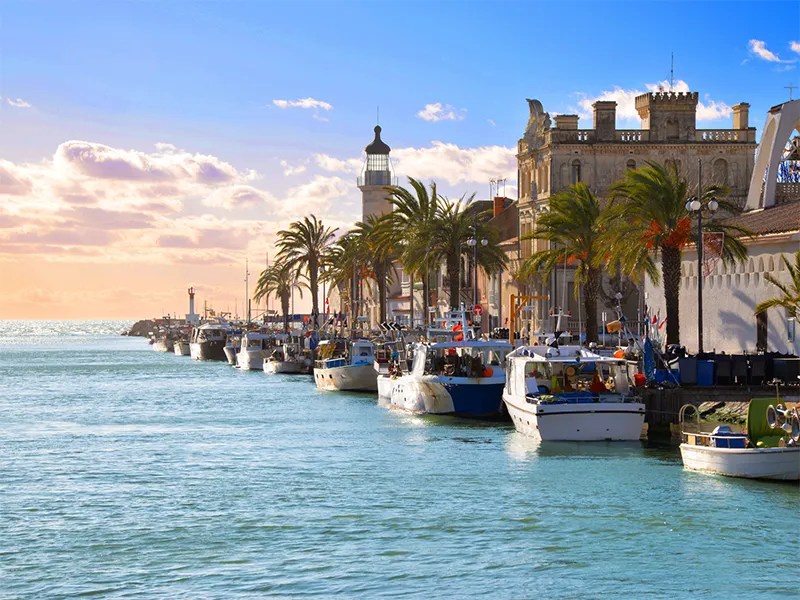
The Rade de Toulon is more than your average French port with quaint cafes and that little white tourist train that can be found throughout the country’s cutest towns. It’s a military port and France’s naval base, home to the gargantuan aircraft carriers FS Charles de Gaulle and FS Clemenceau. It’s daunting to look up from the petits water taxis that connect Toulon with La Seyne-sur-Mer, Plage des Sablettes, and Saint-Mandrier-sur-Mer. Other staples in the port are the epic Corsica Ferries – Sardinia Ferries yellow ship and the Batelier de la Côte d’Azur ferry to Île de Porquerolles. Ensure that a day trip to Île de Porquerolles is on your agenda – it simply cannot be missed.
Whether you’re headed to Toulon for a beach day or ready to move in for a month, there is one thing to know that I’ve learned firsthand. Toulon might never be as recognized as its sibling Marseille, or its neighbors on the Côte d’Azur, but that’s exactly its appeal. Choosing Toulon as my first home in France proved to be a worthwhile calculation. When your time is split between the beach, the market, and the water, your deathbed self can rest.
Katherine Scott Bazley is a travel writer who has been navigating the Mediterranean for over a decade, recently calling France home. She is Editor of Après Sky and can be found at Sense of Place on Substack
The post Life in Toulon, Le Var appeared first on The Good Life France.