








:quality(85):upscale()/2026/04/10/039/n/1922283/cb3481e569d98e495097f0.31125477_.jpg)
:quality(85):upscale()/2026/03/16/901/n/1922398/7098afdb69b86a52587585.46389067_.jpg)
:quality(85):upscale()/2025/08/14/650/n/1922283/470aeb83689df49cdc1bb6.14084110_.jpg)
:quality(85):upscale()/2023/10/03/668/n/1922283/1f15c8a9651c2d209e5eb5.32783075_.jpg)
:quality(85):upscale()/2025/09/09/891/n/1922283/7222624268c08ccba1c9a3.01436482_.png)










What Time Was It 9 Hours Ago?
Ever found yourself staring at a timestamp and wondering, “what time was that in my local time?” Or trying to figure out when a meeting actually happened, when a medication was last taken, or when a server log entry was recorded? Calculating what time it was 9 hours ago is a surprisingly common need — and this guide walks you through every method, scenario, and shortcut to get the answer instantly.
Introduction: Why People Need to Know What Time It Was Hours Ago
Time is something we rarely think about until it suddenly matters. You might receive a message with a timestamp in a foreign time zone, or wake up and wonder when exactly you fell asleep. Maybe your cloud service logged an outage and you need to map that timestamp to your local clock. Whatever the trigger, the question “what time was it X hours ago?” comes up more often than most people expect.
The search phrase “what time was it 9 hours ago” sees thousands of daily queries worldwide, driven by remote workers coordinating across continents, travelers calculating arrival times, and developers debugging time-sensitive applications. Nine hours in particular is a common offset — it’s the difference between IST and PST, roughly the length of a transatlantic flight, and often the gap between a morning shift and an evening one.
The good news: once you understand the simple formula behind it, you can answer this question in seconds — mentally, with a calculator, or with a tool like the one at the top of this page that updates live every second.
How to Calculate What Time It Was 9 Hours Ago
The core calculation is simple subtraction: take the current time and subtract 9 hours. But depending on the time of day, a few things can trip you up — especially AM/PM transitions and midnight crossovers.
Step 1: Identify your current time. Use your local device clock. Make sure you know whether you’re working in a 12-hour (AM/PM) or 24-hour format, as this affects how you handle the subtraction.
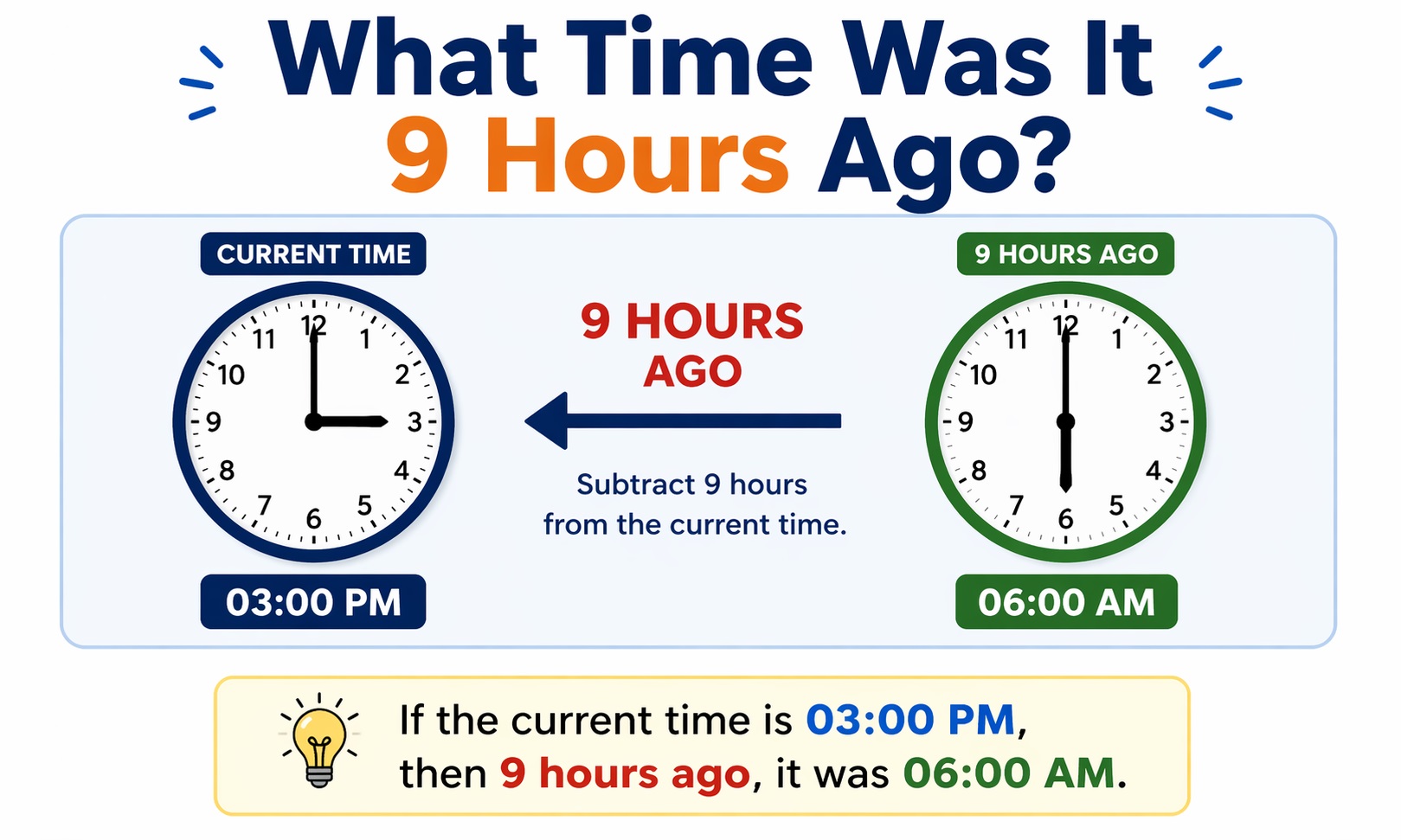
Step 2: Subtract 9 from the hour value. If the current hour is 10 or greater, this is straightforward. For example, if it’s 3:45 PM (15:45 in 24-hour time), subtracting 9 gives you 6:45 AM. Simple.
Step 3: Handle AM/PM transitions carefully. This is where most people make mistakes. If the current time is, say, 8:00 AM and you subtract 9 hours, you get -1:00 — which wraps around to 11:00 PM the previous day. To handle this, convert to 24-hour format first, do the subtraction, then convert back. If the result is negative, add 24 to get the correct hour and note that the result is from the prior calendar day.
Quick example: Current time is 6:00 AM. In 24-hour format that’s 6:00. Subtract 9: 6 − 9 = −3. Add 24: 21:00. Convert back: 9:00 PM the previous evening.
Step 4: Note the date. Whenever your subtracted time crosses midnight (i.e., the result is from 12:00 AM onward on the previous day), make sure to account for the date change. This matters most for log timestamps, meeting records, and medication schedules.
Quick Reference Table: 9 Hours Ago by Time of Day
If you need a fast lookup without any mental math, use the reference table below. It covers the most common times across the full 24-hour cycle and shows exactly what time it was 9 hours prior. Times that cross into the previous day are clearly marked.
| Current Time | 9 Hours Ago | Day Change? |
|---|---|---|
| 12:00 AM (Midnight) | 3:00 PM | Yes — previous day |
| 1:00 AM | 4:00 PM | Yes — previous day |
| 3:00 AM | 6:00 PM | Yes — previous day |
| 6:00 AM | 9:00 PM | Yes — previous day |
| 9:00 AM | 12:00 AM (Midnight) | Yes — previous day |
| 12:00 PM (Noon) | 3:00 AM | No — same day |
| 3:00 PM | 6:00 AM | No — same day |
| 6:00 PM | 9:00 AM | No — same day |
| 9:00 PM | 12:00 PM (Noon) | No — same day |
| 11:00 PM | 2:00 PM | No — same day |
Notice that any current time before 9:00 AM will push the result into the previous calendar day. This is one of the most common sources of confusion when tracking past events, so always double-check the date when working with early morning timestamps.
Time Zones & Why They Matter
Calculating 9 hours ago gets more nuanced the moment time zones enter the picture. If you and a colleague are in different parts of the world, “9 hours ago” describes a different clock time for each of you — even though you both experienced the same moment in history.
UTC (Coordinated Universal Time) is the global reference standard that all time zones are measured against. When working with international timestamps — especially in software, finance, or aviation — it’s best practice to convert everything to UTC first, perform your arithmetic, then convert back to the desired local time zone.
Here’s a practical example. If it’s currently 10:00 AM IST (India Standard Time, UTC+5:30), then 9 hours ago was 1:00 AM IST. But for someone in New York on EST (UTC−5), the same moment — 9 hours ago from their perspective — was 8:00 PM EST the previous evening. And someone in Los Angeles on PST (UTC−8) would say it was 5:00 PM PST the day before.
Daylight Saving Time (DST) adds another layer. Twice a year, many countries shift their clocks forward or backward by one hour. If your 9-hour subtraction crosses a DST boundary, the actual elapsed wall-clock time may differ from what simple arithmetic suggests. Online time zone converters and programming libraries (like Python’s pytz or JavaScript’s Luxon) handle DST automatically, which is why they’re preferable to manual calculations for mission-critical use cases.
Tools to Calculate Past Time Instantly
While the mental math is learnable, most people prefer a reliable tool — especially for time-zone-aware calculations. Here are the best options depending on your situation.
The calculator on this page is the fastest starting point. It reads your device’s local clock in real time and subtracts however many hours you enter. No setup, no sign-in, no installation needed.
Google Search understands natural language time queries. Typing “what time was it 9 hours ago” directly into Google will often surface a quick-answer card. For cross-timezone queries, try “9:00 AM IST in PST” and Google will convert it instantly.
timeanddate.com is the gold standard for time zone arithmetic. Its “Time Zone Converter” and “Meeting Planner” tools let you specify exact dates, times, and zones — essential for coordinating international meetings or verifying log timestamps.
For developers, a quick snippet does the job in seconds. In JavaScript: new Date(Date.now() - 9 * 3600 * 1000). In Python: datetime.now() - timedelta(hours=9). Both return a full timestamp with date, accounting for midnight rollovers automatically.
Smartphone world clocks are underrated for this. On iOS, open the Clock app and add multiple cities to “World Clock.” The time offset between cities is shown at a glance, making it easy to reason about what time it is — or was — anywhere in the world.
Common Scenarios Where Knowing the Past Time Matters
The question “what time was it 9 hours ago?” might sound academic, but it shows up in surprisingly practical situations across work, health, travel, and technology.
Work & Productivity. Remote teams spread across time zones frequently need to verify when a task was completed, when a Slack message was sent, or when a document was last edited. If a colleague in Singapore sent a file “at 9 PM their time” and you’re in London, knowing that was 9 hours ago helps you understand whether it arrived before or after your morning standup.
Travel. Long-haul flights spanning 8–14 hours make time arithmetic unavoidable. Travelers routinely calculate departure times, layover durations, and local arrival times. If your flight took 9 hours and you landed at noon, you left at 3:00 AM — or possibly the day before, depending on time zone changes along the route.
Technology & Development. Server logs, API call histories, database entries, and error reports all carry timestamps — usually in UTC. When an outage is reported and the log says it started 9 hours ago, engineers need to map that back to their local time to understand whether it happened during business hours, overnight, or at a critical deployment window.
Health & Wellness. Medication schedules often require doses taken every 8, 12, or 24 hours. If you’re unsure whether you took a pill, knowing what time it was 9 hours ago helps you verify against your last memory of taking it. Similarly, intermittent fasting trackers and sleep cycle apps rely on precise backwards time calculations to log windows accurately.
Finance & Markets. Stock markets open and close at specific local times. Traders in different regions often need to know what the market was doing “9 hours ago” — which for someone in Mumbai asking about Wall Street might translate to a specific segment of the previous day’s trading session.
Frequently Asked Questions
If the current time is midnight (12:00 AM), then 9 hours ago it was 3:00 PM the previous day. Midnight in 24-hour format is 00:00. Subtracting 9 gives −9, which wraps back to 15:00 (3:00 PM) on the day before. This is one of the trickiest cases because it involves both a time change and a date change.
Yes, if your 9-hour window crosses a DST transition. Twice a year, clocks spring forward or fall back by one hour. If that happens within your 9-hour window, the actual elapsed clock time is either 8 or 10 hours, not 9. For everyday use this rarely causes a practical problem, but for precise scientific, financial, or legal timestamps, always use a DST-aware tool or programming library.
The simplest method: convert both your current time and the target time zone to UTC, subtract 9 hours, then convert back. For example, if it’s 6:00 PM UTC and you want to know what time it was 9 hours ago in IST (UTC+5:30), subtract 9 hours from UTC to get 9:00 AM UTC, then add 5 hours 30 minutes to get 2:30 PM IST. Online tools like timeanddate.com handle this in one step.
No. If the current time is before 9:00 AM, then 9 hours ago was on the previous calendar day. For example, if it’s currently 7:00 AM on Wednesday, then 9 hours ago it was 10:00 PM on Tuesday. The live calculator at the top of this page automatically detects this and labels the result as “previous day” when applicable.
The fastest way without installing anything is to open your phone’s default calculator, type your current hour, subtract 9, and check the sign. If it’s negative, add 24 for the correct hour and note it’s the previous day. Alternatively, use the calculator embedded at the top of this page — it does everything automatically and updates in real time.
Conclusion
Figuring out what time it was 9 hours ago comes down to one simple idea: subtract 9 from your current hour, and watch for the midnight boundary. If the result dips below zero, you’ve crossed into the previous day — add 24 to recover the correct hour.
For most everyday situations — checking when a message arrived, figuring out a medication window, or tracing back a meeting time — the mental math is enough. For anything involving time zones, Daylight Saving Time, or precise technical logging, reach for a dedicated tool. The live calculator at the top of this page handles the arithmetic automatically and works entirely in your browser with no data sent anywhere.
Time moves forward whether we track it or not. Having a reliable way to look backwards — even just 9 hours — gives you the context to make better decisions, resolve confusion faster, and stay in sync with the people and systems around you.
The post What Time Was It 9 Hours Ago? appeared first on Entrepreneurship Life.