Buying and renovating a property in Paris
 Tomas k - Senior News Editor
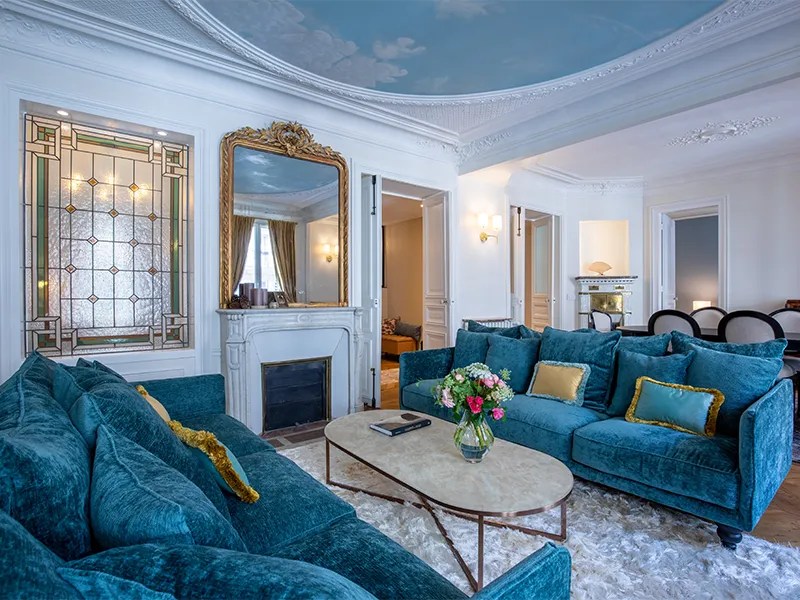

If you’re dreaming of buying and renovating a property in Paris, there’s lots to consider from where to live, to what type of buildings and whether you can find the right artisans and services to create your perfect Paris pad. Antonia Mahon, Founder of Blue Sparks Paris, an interior design and property search company, answers some of the most common questions about buying and refurbishing a Paris property
What do most buyers get wrong when searching for a Paris apartment?

The biggest mistake is reacting to the surface rather than reading the space. Paris apartments, especially in the older Haussmann and pre-war buildings that give the city its character, often show up at their worst — tired paintwork, dated kitchens, awkward layouts accumulated over decades of piecemeal updates. Many buyers walk away from exactly the apartment that could have been perfect for them.
The reverse is equally common. A beautifully staged apartment can mask a great deal — poor light, heavy co-ownership charges, a building quietly heading towards major works. First impressions in Paris can be very misleading, in both directions.
The skill is learning to look past all of that and ask: what are the bones of this place? What is the light doing? What could this become? In a city where the buildings themselves are the raw material — with their ceiling heights, their parquet, their fireplaces, their stone — that question is always worth asking.
How do you evaluate a Paris apartment’s true potential when you walk in for the first time?

Paris is a city of genuinely hidden surprises. Behind a false ceiling, there may be magnificent original cornicing and plasterwork. Under layers of carpet, original parquet in near-perfect condition. A seemingly dark apartment may need nothing more than a strategic opening of the floor plan to be transformed by light.
The moment I step into a space, I’m reading it on several levels at once — the orientation, the ceiling height, the flow between rooms, the quality of the original features, what the structure will and won’t allow. Living and working in Paris for 27 years means I also know the buildings themselves: how a typical Haussmann layout behaves, where the load-bearing walls tend to be, which period details are likely to be hiding beneath later additions.
The other thing I’m doing from the very first visit, is building a realistic picture of what any transformation would cost — so that the full investment is understood before any decisions are made, not after.
Which Paris arrondissements offer the best value for a budget of €700k–€1.5M — and which are overrated?

Paris is best understood as a collection of villages, each with its own personality and rhythm. The most important question is rarely which arrondissement is objectively “best” — it’s which one suits how you actually want to live.
That said, there is real value to be found if you know where to look. Areas like parts of the 11th, the 13th, and quartiers such as Buttes-Chaumont in the 19th arrondissement offer beautiful buildings, genuine neighbourhood life, and real character at prices well below the more established addresses. Of course, the 6th, 7th, and the golden triangle of the 8th will always command a premium — and buyers sometimes overlook the fact that a smaller, well-chosen apartment in a more prestigious location can be a stronger long-term asset than a larger one elsewhere.
With a budget of €700k to €1.5M (2026-2027) there is meaningful choice in this market. But the detail that matters most is often not the arrondissement — it’s the specific street, the orientation, the surrounding buildings, the condition of the building itself. Two apartments in the same postcode can be very different propositions. That level of granularity comes from being present, embedded, and genuinely attentive to how this city works.
What are the red flags that most people walk straight past when considering Paris properties?

There are several, and they are rarely visible in the listing photographs.
The building itself tells you a great deal before you’ve even stepped inside — the condition of the parties communes (shared areas), the general upkeep of the façade and entrance.
But the less visible risks are just as important. In France, buyers inherit any works already approved by the co-owners of the building, and those can run to significant sums. The only way to know what’s coming is to analyse the minutes of the assemblées générales — the AGM records of the syndic (the property management company mandated by the co-owners) — which document decisions made, works voted, and perhaps more revealingly, works that were raised but not voted through. Disputes in progress, recurring maintenance issues, a building that keeps deferring necessary expenditure — it’s all in there, if you know how to read it.
It’s painstaking work, and it requires fluent French. AI tools can now help process these documents and give a general orientation, but there is a difference between extracting information and knowing what it means in context — understanding, for instance, why a vote was deferred, or what a particular type of dispute signals about the dynamics of a co-ownership.
Inside the apartment, the DPE (energy performance rating) deserves close attention — not just as a number on a form, but as a real indicator of comfort through both summer heat and winter cold, and increasingly of resale and rental value as French regulations tighten. Orientation is equally fundamental: a north-facing apartment with small windows is a categorically different living experience from one that catches the afternoon sun, and no amount of interior design fully compensates for the absence of natural light.
Noise is another factor that photographs and floor plans will never reveal — whether it comes from the street, an active courtyard, or the floors above. It’s the kind of thing that only becomes apparent over time. When shortlisting properties for our clients, we always visit on different days and at different times precisely for this reason. Paris has its own rhythms, and an apartment that feels peaceful on a quiet Tuesday morning may tell a very different story on a Friday evening.
And then there are the questions that need to be asked directly — of the agent, the gardien, and if possible, the neighbours. Being able to have those conversations in French, and to read what’s being said as much as what isn’t, changes the quality of information you come away with considerably.
Can combining the property search with interior design save buyers money in the long run?

It changes the decision-making from the very beginning. When design is part of the picture from day one — not just renovation costs, but how the clients actually want to live, how they want the space to feel, what the apartment needs to become for them — that vision is folded into every viewing and every offer. The question is never just “is this a good apartment?” but “is this the right apartment for this particular person and how they want to enjoy Paris?”
That means the full investment — acquisition price, transformation, furnishings, the complete picture — is understood before any decisions are made, not after. Buyers aren’t discovering six months later that bringing an apartment up to standard will cost significantly more than they had assumed, or that the layout doesn’t actually lend itself to how they want to live.
There’s also a practical efficiency once the property is secured. Rather than starting over with a designer who needs to learn the brief, understand the building, and navigate the local artisan and supplier landscape from scratch, the design process begins immediately and with full context — covering not just the works themselves but the aesthetics, the furnishings, the way the finished home will look and feel. In a city where good craftspeople are in demand and lead times can be long, that continuity matters.
Perhaps most importantly, having chosen a property with its transformation already in mind tends to produce more resolved, more personal results. The design isn’t retrofitted to a space — the space was chosen with the design, and the lifestyle, already in mind.
For someone buying in Paris for the first time — what’s the one piece of advice you would give?

Don’t arrive with a fixed list of ‘must haves’.
Paris is full of apartments that look unremarkable on paper and become genuinely beautiful homes once the right things are done to them. The ceiling heights, the proportions, the quality of the light in a well-oriented room — these are Parisian gifts that are very hard to replicate elsewhere, and they reward the kind of design thinking that takes them seriously.
The other thing worth understanding before you start is that buying in France is a genuinely different process from buying in the UK, Ireland, the US, or most other countries. The notaire system, the co-ownership framework, the rules around renovation works, the way negotiations actually happen — there are layers of complexity that aren’t immediately obvious, and they can wrong-foot even experienced buyers. Going in well-informed, or with someone who knows the terrain, makes an enormous difference to how the experience unfolds.
Paris properties reward patience, knowledge and respect (a bit like Parisians themselves!). The right apartment, understood properly, can be something quite extraordinary.
See Antonia’s top tips for Paris property buyers, and get a free guide to buying in Paris at bluesparks.com
The post Buying and renovating a property in Paris appeared first on The Good Life France.