Discover the Belleville district of Paris
 Tomas k - Senior News Editor

The Belleville district of Paris – gastronomic, historic, and cosmopolitan – it’s one of the less well-known parts of Paris but is well worth a visit says writer Carolyn Boyd.
In Paris, the most visited city in the world, it can be a challenge to shrug off the identity of ‘tourist’. There is much to give you away: your head is often buried in the Google Maps app, servers and shop staff will switch to English at the slightest hint of a British or American accent, and there’s no hiding you’re an outsider when you stop to take photos of the sunlight drenching the elegant Haussmann architecture. Parisians might take such beauty for granted – they see it every day, after all. Yet my short stay in the Belleville neighbourhood of the 20th arrondissement showed me there is a place in this endlessly fascinating city where you can feel like you belong, a place where it is possible to feel Parisian.
Discover the Belleville district of Paris

Arriving late one Thursday night, the bars around my hotel on Boulevard de Belleville, are buzzing with people chatting and soaking up the warmth of an autumn evening. By the morning, the chatter has shifted to a different tone, but it is no less thrilling. The street is filled with market stalls, set up under the verdant sophora trees. For as far as my eye can see along the long boulevard, there are displays of enticing produce: glossy tomatoes, golden Mirabelle plums and spiky pineapples.
Cheese stalls tempt with unctuous Camemberts, fruity Comtés and creamy Brillat-Savarins; charcuterie and boucherie stalls offer locals their Saturday night dinners and Sunday lunches. The soundtrack to accompany the abundant scene is a cacophony of stallholders hollering, locals greeting each other and the trundle of many a chariot de courses, the striped shopping trolley de rigueur for any market visit. If I had an apartment here, I’d be filling mine too.

Just around the corner on rue de Belleville, before the street starts its steep climb to the top of its famous hill, I find a neighbourhood institution: the bar Aux Folies. The night before, its terrace had been rammed with revellers but the clientele this morning is a little more sedate; a few elderly gentlemen sip espresso coffees and puff on cigarettes, a couple of students tear apart their croissants. I take a seat on the terrace too, enjoying a morning café crème to fuel my onward wander. I venture inside to pay and get a chance to admire the interior.
On the ceiling, swirls of neon lights mirror the tiled swirls of the mosaic floor, a zinc-topped bar is stacked with saucers ready for clients’ bills and the walls, a hall of mirrors. The barman Ouali tells me a bit more about its history which dates from the early 20th century. “It was built first as a bar to serve those going to the theatre which then was where the Carrefour supermarket is now,” he explains. “Aux Folies started out as a hairdressers’ salon, so they kept all the mirrors and added more features after World War II, in the 1950s. Since then, it’s pretty much stayed as it was.” While the surrounding buildings have changed, Aux Folies has done well to survive, despite several challenges, such as floods, deterioration and being destabilised by underground trains. “The vibrations from the nearby metro weakened the foundations. We had to work with one of the only two companies in France experienced in stabilising foundations. They brought in special equipment, and it worked,” he says.
Further up the hill, as I cross the road, there is a fantastic view of the Eiffel Tower in the distance, framed by the street’s mishmash of old and new architecture, decorated with pops of colour from street-art and graffiti.
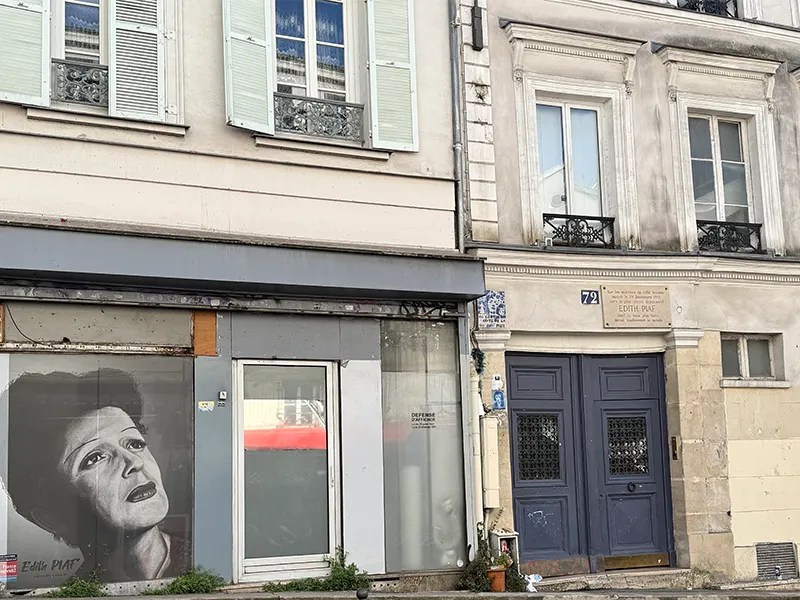
Here, I find a tribute to the district’s most famous daughter – Edith Piaf, who is said to have sung at Aux Folies. A plaque states that at 72 rue de Belleville on 19th December 1915, the legendary chanteuse was born on the steps. “Later, her voice would turn the world upside down,” it reads. In the window in the building next door, there’s a giant portrait, her pained face gazes skyward. In her day, immigration carved the character of Belleville and that remains true today; on this same street there are glimpses of the world beyond France: there’s the Thai restaurant Ama Siam, and in Epicerie La Caire I find a cornucopia of North African and Eastern Mediterranean spices and sauces and beans; in the Bazar de Belleville, there are leather bags, toys and knick-knacks.

Among the first wave of newcomers to arrive in Paris, however, were France’s own immigrants such as the Auvergnats. They came from the mountain villages of the Auvergne in central France to sell coal to Parisians, then little by little they began to sell wine from their home region and then food, being the first to establish the city’s cafés. One of those very places is Le Mistral, at the crossroads between rue des Pyrenées and rue de Belleville, where the region’s signature dish saucisse-aligot – sausage and smooth, cheesy mashed potato, takes pride of place on the menu. It was this dish that inspired author Chris Newens’ book Moveable Feasts, which takes a journey around Paris’ 20 arrondissements discovering the dish that best represents each district.
Later, after I’ve explored the area’s beautiful Parc des Buttes Chaumont, I meet Chris at Le Mistral for dinner of saucisse-aligot, and the next day he shows me around his neighbourhood. Having lived in Paris for ten years, he has come to know the 19th and 20th arrondissements well. “For me, it’s a much better city to be in when you’re not doing the touristy things,” he says. “The tourist sites in Paris aren’t very interactive, so when you’re looking at the Eiffel Tower, you’re just looking at it, same with Les Invalides and many of the bigger sites. So, the best way to experience the city is to sit in a café with a book, or to wander around the outer districts.”
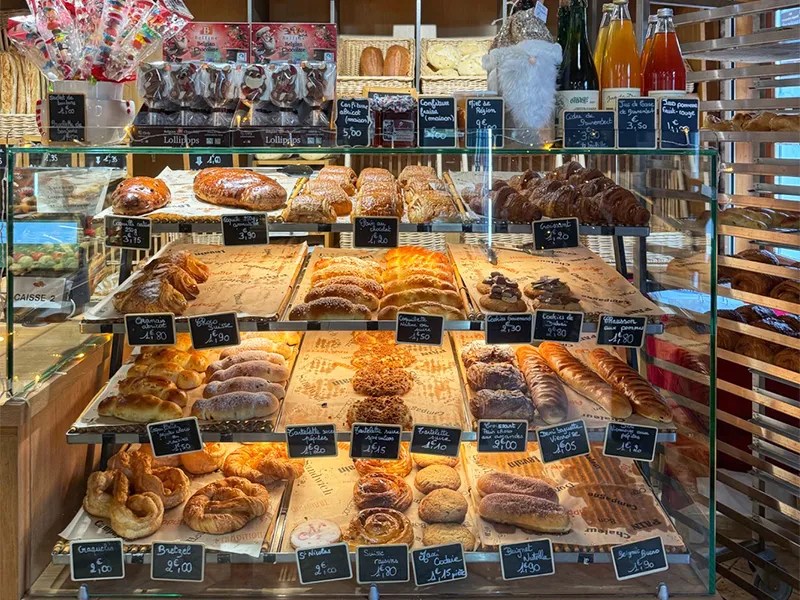
And with that, we wander. From the terrace of the Bar Fleuri, on Rue du Plateau, where we lunch on plates of its famous poulet-frites, we become flâneurs and take the winding back streets admiring the bright mosaic façade of a former poissonnerie on Rue de la Mare, and breathing in the aroma of freshly baked croissants as we walk past the boulangerie Aux Delices des Quatre Saisons. Down another side street, the Rue des Cascades, feels decidedly village-like, a small building shows a plaque written in Latin that suggests it was once a well.
On the corner of Rue des Envierges and Rue Piat a little hub of brightly painted restaurants, including Mon Coeur Belleville and the vegan restaurant Les Bols d’Antoine, overlooks the trees in the Parc de Belleville, while a small craft market has set up between the pillars at the Belvedere de Belleville. Over the fence of the park, I spot the majestic Eiffel Tower and gasp at the spectacular view, a little reminder that, yes, I’m still in the City of Lights, but what a glorious district in which to play at being Parisian.
Carolyn Boyd is the author of Amuse Bouche: How to Eat Your Way Around France, and runs the popular newsletter France Traveller francetraveller.substack.com
Want more France?
Discover more fabulous destinations in France with our free magazine The Good Life France
Love France? Have a listen to our podcast – everything you want to know about France and more!
All rights reserved. This article may not be published, broadcast, rewritten (including translated) or redistributed without written permission.
The post Discover the Belleville district of Paris appeared first on The Good Life France.