Handshakes, Hugs and Eye Contact: A French Guide to Polite Distance
 Tomas k - Senior News Editor
As a child, I was impressed when an adult shook my hand. Gradually, handshakes became more frequent and signaled everything from making up after a schoolyard fight to joining a secret gang. Hugs, however, were taboo except for consolation after a tragedy. Eye contact was related to social status. Without embellishing it, I will just report that the only time I remember making eye contact with a teacher, I was accused of dumb insolence.
Undeterred, I grew up cheerfully shaking hands with strangers and acquaintances, hugging close friends and relatives. I kiss my wife. But in France, this clarity of purpose grossly oversimplifies essential signs and social signals. In France, every encounter is an anthropological probe into politeness with three questions.
Do we shake hands?
Do we kiss?
How long is eye contact?
Only after these matters are settled may conversation begin.
Armed with my anthropological assessment tool, I assumed my interpersonal calculations would become faster and easier with experience. Instead, I merely became more aware of increasing numbers of nuances. Like all French anthropology, politeness infinitely refines obscure complexities and avoids helpful clarity.
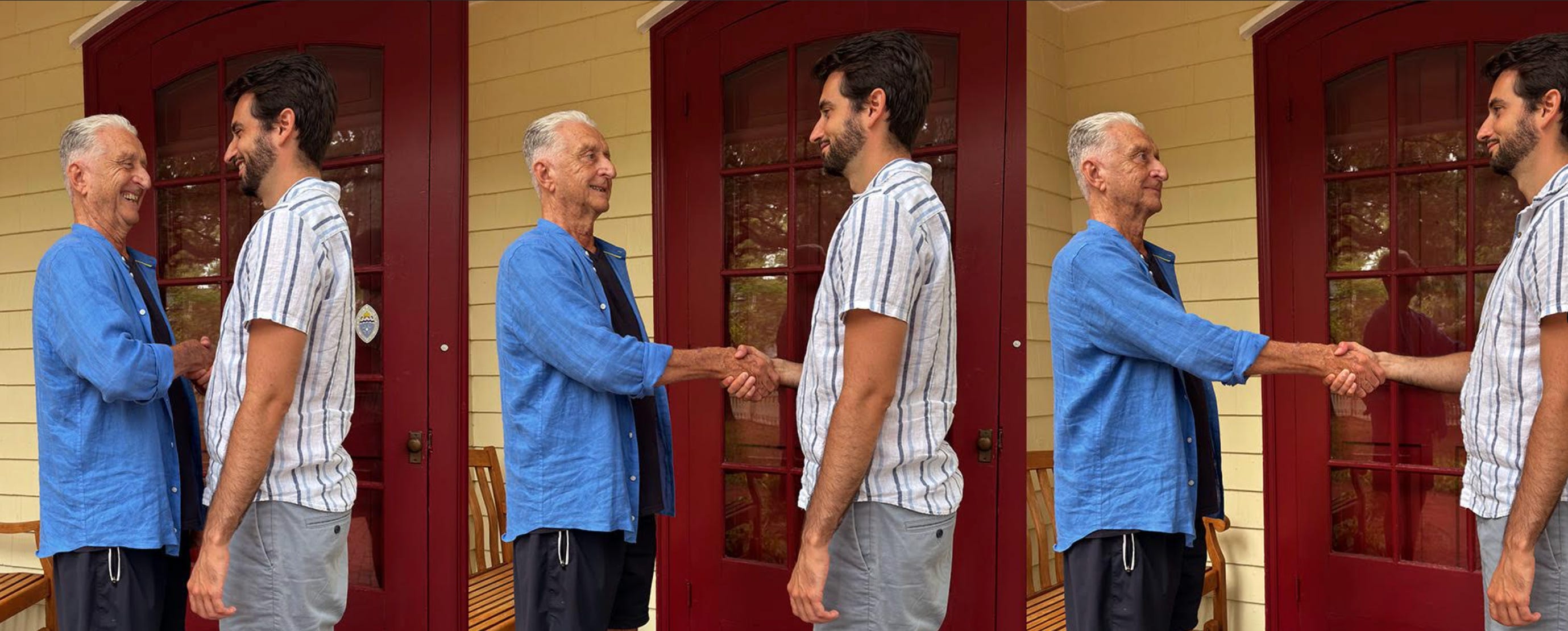
The handshake itself is simple, but esoteric protocols govern it. At an official level, the French handshake carries legislative weight. French labor law—Article L 1132-1 of the Labor Code—recognizes that refusing to shake someone’s hand can, in certain circumstances, become evidence of discrimination. Meanwhile, etiquette authorities such as the Institut Français leave little to the imagination. In professional settings, the protocol is precise: one firm handshake on arrival, another on departure. If you omit to shake one colleague’s hand, however, you disrupt the social equilibrium. The omitted person may say nothing, but the omission hangs on. Some workplace colleagues shake hands every morning, as though to renew a treaty that expired overnight and confirm that civilization continues.
The handshake also has a gender influence. Recently, my wife and I were with old friends, and a newcomer joined us. Roberta put out her hand to introduce herself, so he took her hand and then gave her a bise. When I offered my hand, he took it without offering his cheek. This reflects a typical gender pattern of more bise between and toward females than males.
He certainly did not offer to hug either of us: the casual hug is rare. It is generally reserved for family, close friends or moments of genuine emotion. This is the only bit of French politesse that I understand unequivocally.
Unlike hugs, however, eye contact is important and ubiquitous. The complete French greeting is not only a word but a visible existential acknowledgment. One glance can establish the other person’s existence as an amiable associate, suspicious alien, ally or co-conspirator. The glint-greeting has a silent code. The eyes set the stage for what the voice enacts.
Too little eye contact and you appear distracted, evasive or discourteous. Too much and the exchange begins to resemble either an interrogation, defiance or falling in love. The French appear to possess an instinctive understanding of the precise interval required: long enough to establish presence, brief enough to avoid consequences.
Foreigners are left to wonder. But here’s my guide:
Look for one second, and it’s a Bonjour.
Two seconds becomes Oui.
But three seconds is a Quoi?
Or I use eye contact like salt: a pinch to show interest, a sprinkle for emphasis. Too much and the dish is ruined.
These rituals form part of a larger French system of invisible social logistics. Every encounter involves considerations about rank, gender, familiarity and permission. How close should one stand? Has the relationship advanced from vous to tu? Is a first name appropriate? Does the handshake still apply, or has the bise replaced it? Who initiates the change? I guess and listen for clues as the French lingo of politeness remains mute.
Despite the silence, there are distinguishable features. A silent transition occurs when one person decides it has occurred. Warmth is expressed through quiet attention, not effusiveness. A greeting is delivered individually, person by person, not to the room as a whole. Close friends emit their intimacy by glowing to each other. This extraordinary politesse can feel formal at first. It can also feel personal and considerate.
The oldest extant Zen poem, the Xinxin Ming, opens with “The Great Way is not difficult if you avoid preferences.” This may be profoundly true for my Great Way, but my French Way becomes easier only as I refine preferences.
Richard
Introducing Richard Holdsworth:
Visit his Contributor Page — Explore more of Richard’s work