A Day in Annot
 Tomas k - Senior News Editor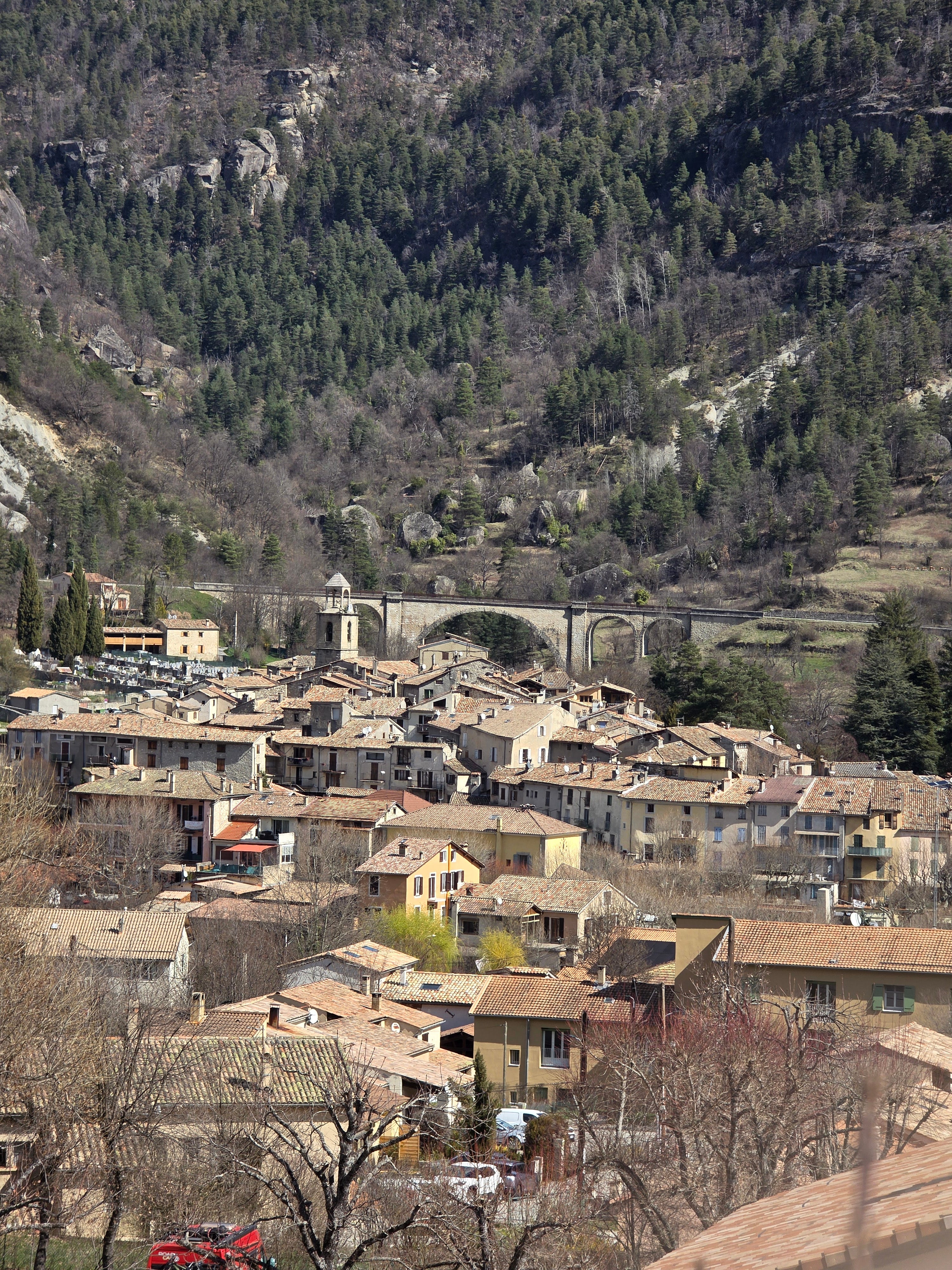
The bus had slowed coming into the square, and I opened my eyes. I’d kept them shut for most of the hour from Point Sublime, because I get carsick on roads like that, and the route along the crest of the Verdon gorge had been an hour of switchbacks. The driver had warned us when we got back on. He’d handed out bags to anyone who wanted them. I took two. I used one halfway through.
What I saw when I looked out was a lively town square. Children with balls. Children trying out skateboards. Parents in small groups, talking. At the far end of the square sat a tall yellow building — three stories, painted the warm yellow you see on buildings in Nice. Three flags hung from its upper floor: the French tricolor, the gold-starred blue of the European Union, and a third I couldn’t place. Liberté, Égalité, Fraternité ran in script across the front. A WWI memorial stood in front. Off to one side, the Vaïre ran fast and clear over its rocks. And then everyone in the square stopped what they were doing and looked up at the bus. They watched us pull in. They watched us get off.
Isabelle, our guide, had told us about Annot earlier in the tour — both the village and the Train des Pignes we’d take from here back to Nice. I hadn’t heard of either before. It made me curious, and I really wanted to see it. I’m always looking for places beyond the big cities.
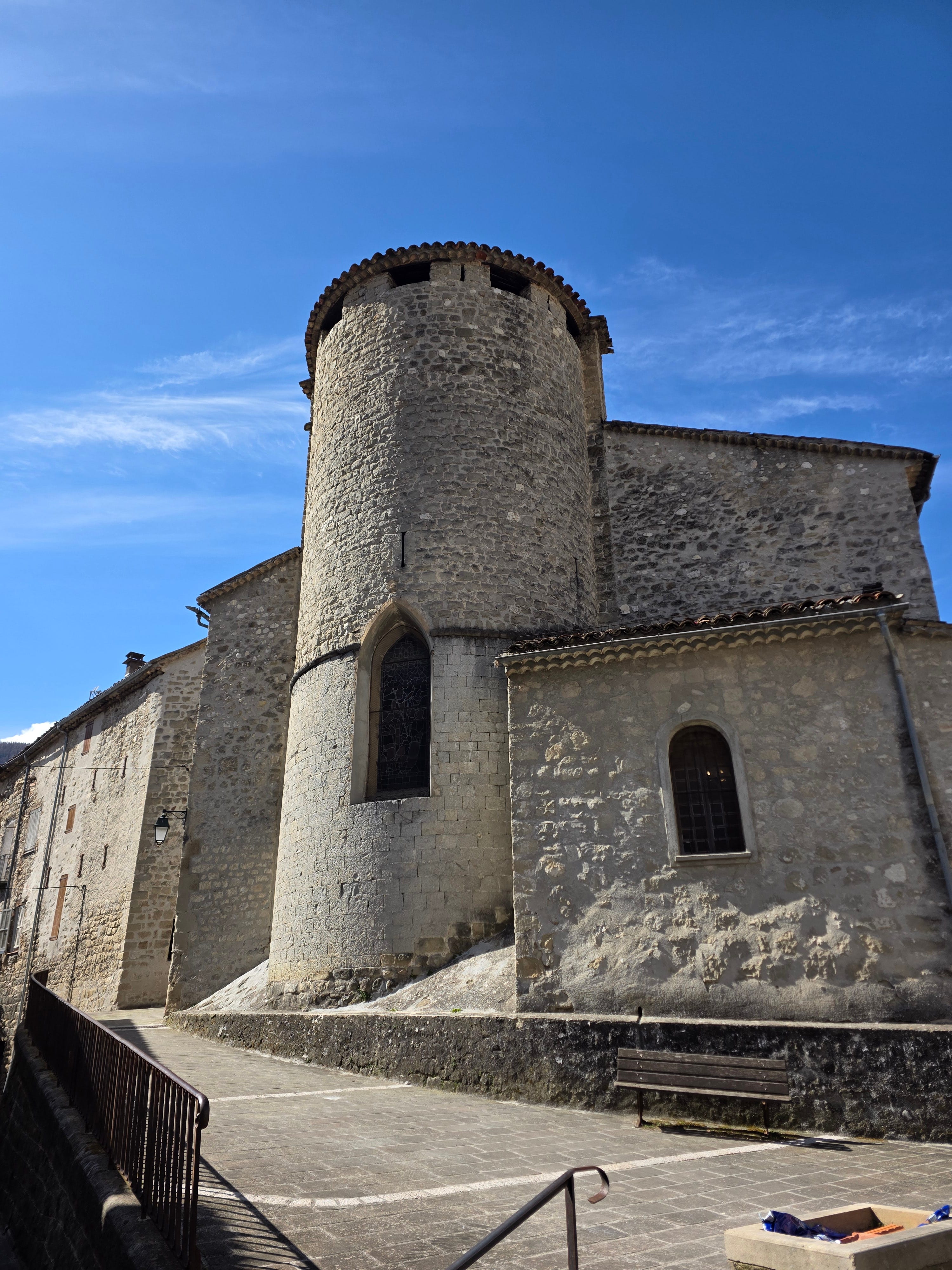
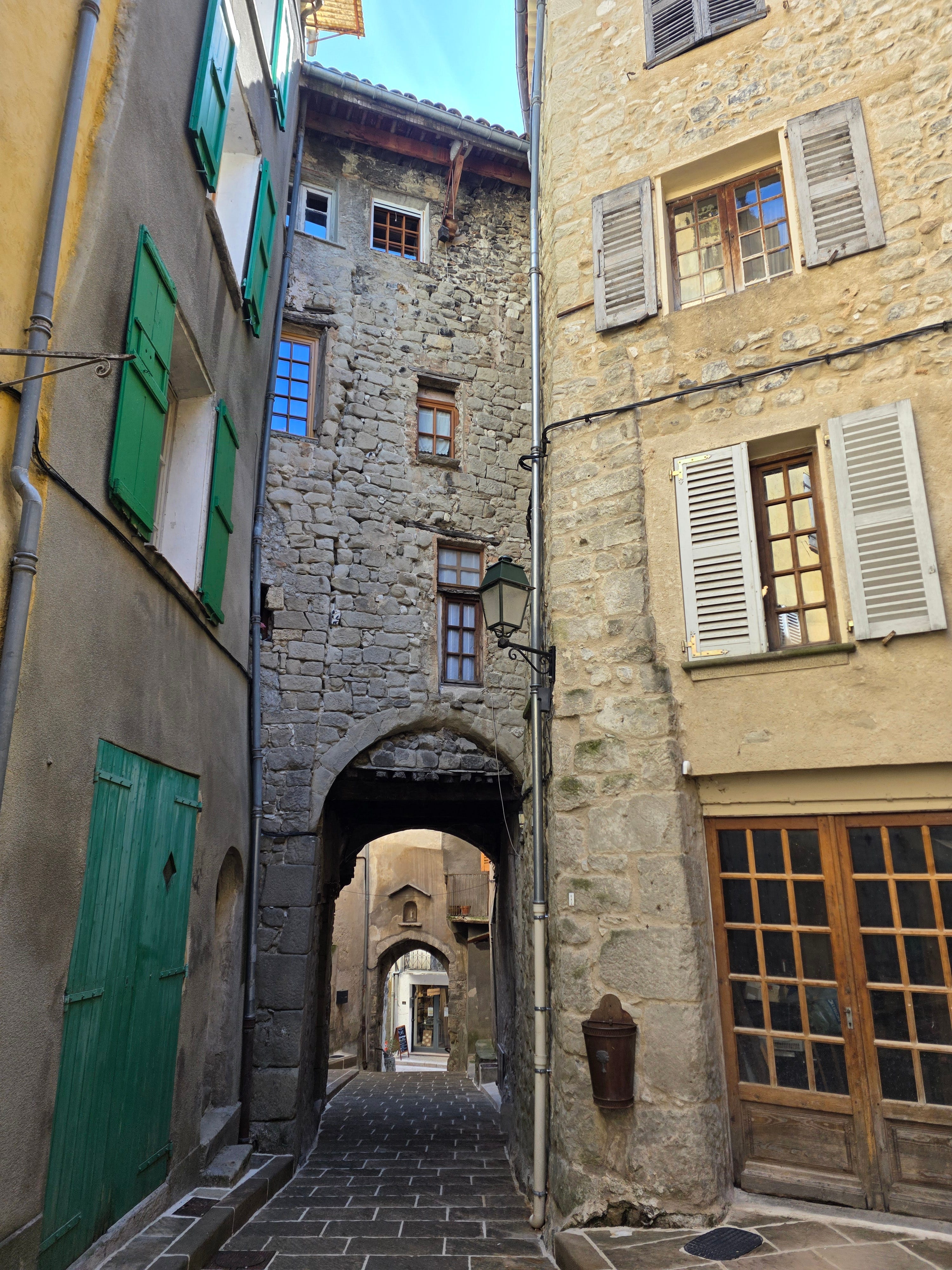
We started walking. The streets were narrow, and the buildings rose on either side in the same pale-gold sandstone as the cliffs above us. Some of them weren’t built so much as carved — sections of rock that had been hollowed out for living, with walls and doors and windows added afterward. Our guide called them troglodyte, the same word I’d learned years ago in the Loire. They keep a constant temperature year-round, and walking past them I could feel the cool air through their open doorways.
I ran my hand along the stone as we went. I always do this with old stone, and my niece Kristen teases me about it whenever she travels with me — don’t touch it. But there was no one here to remind me. The stone felt warm where the morning sun had reached it and cool a few feet on, and I kept doing it. We ended at an open-air theater carved out of the rock, the grès cliffs behind the stage and the mountains beyond. Isabelle told us about the Bravade de Saint-Fortunat — five days every Pentecost when the village dresses in Napoleonic-era uniforms, parades through the streets behind a brass band called l’Echo de la Vaïre, and fires off muskets and cannons in honor of the patron saint. There is a connection to Napoleon, the guide said: many of the village men had once fought in his armies. We stood there a while. On the cliff faces above us, climbers were starting to work their routes. The hiking trails fanned out into the chestnut groves above the village. We didn’t have time for any of that. We had a few minutes to wander before lunch.
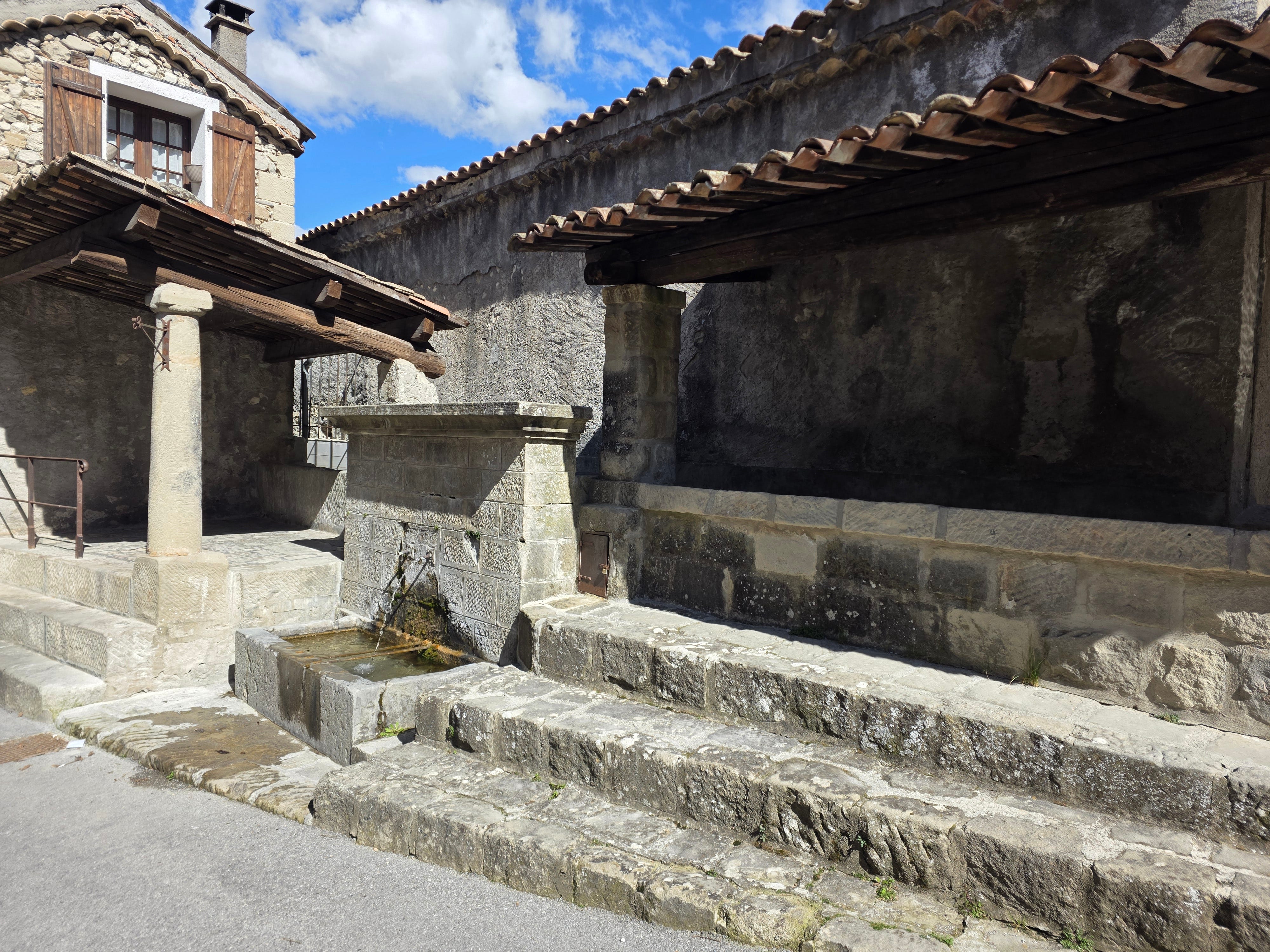
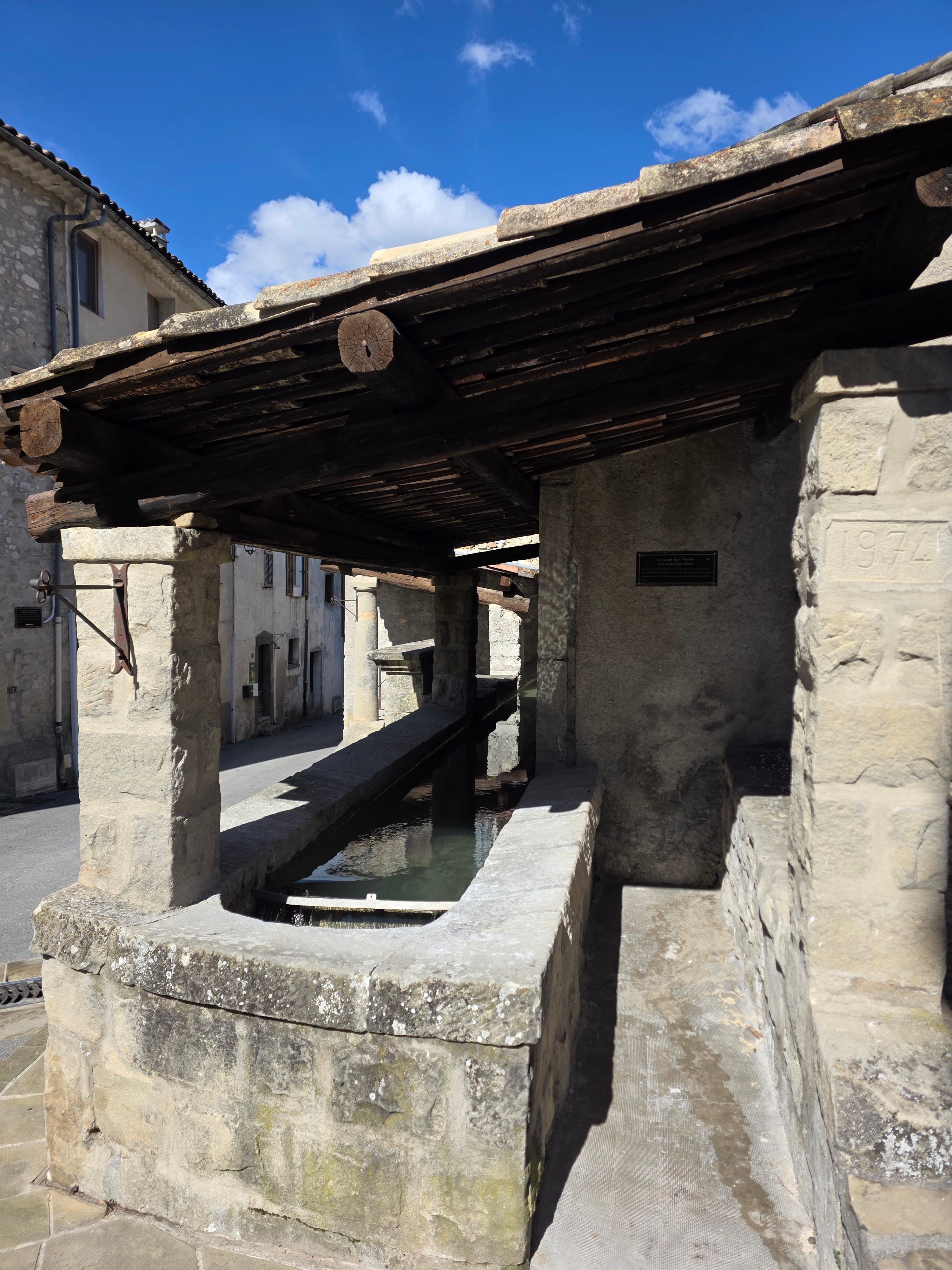
I went off on my own. The group splintered — some heading for coffee, some browsing the lanes — and I followed a small street until I came to the lavoir.
It was a stone basin set into the wall, the water cold and clear, the kind of public washhouse French villages had before indoor plumbing came in. The street around it was quiet. I stood there a while. I always stop at lavoirs when I find them. I was trying to picture the work — how often the women came here, whether they came alone or together, whether they kept it to once a week or once a month, whether they brought the children. Always the women, isn’t it? The girls, not the boys.
By the time I rejoined the group I was starving.
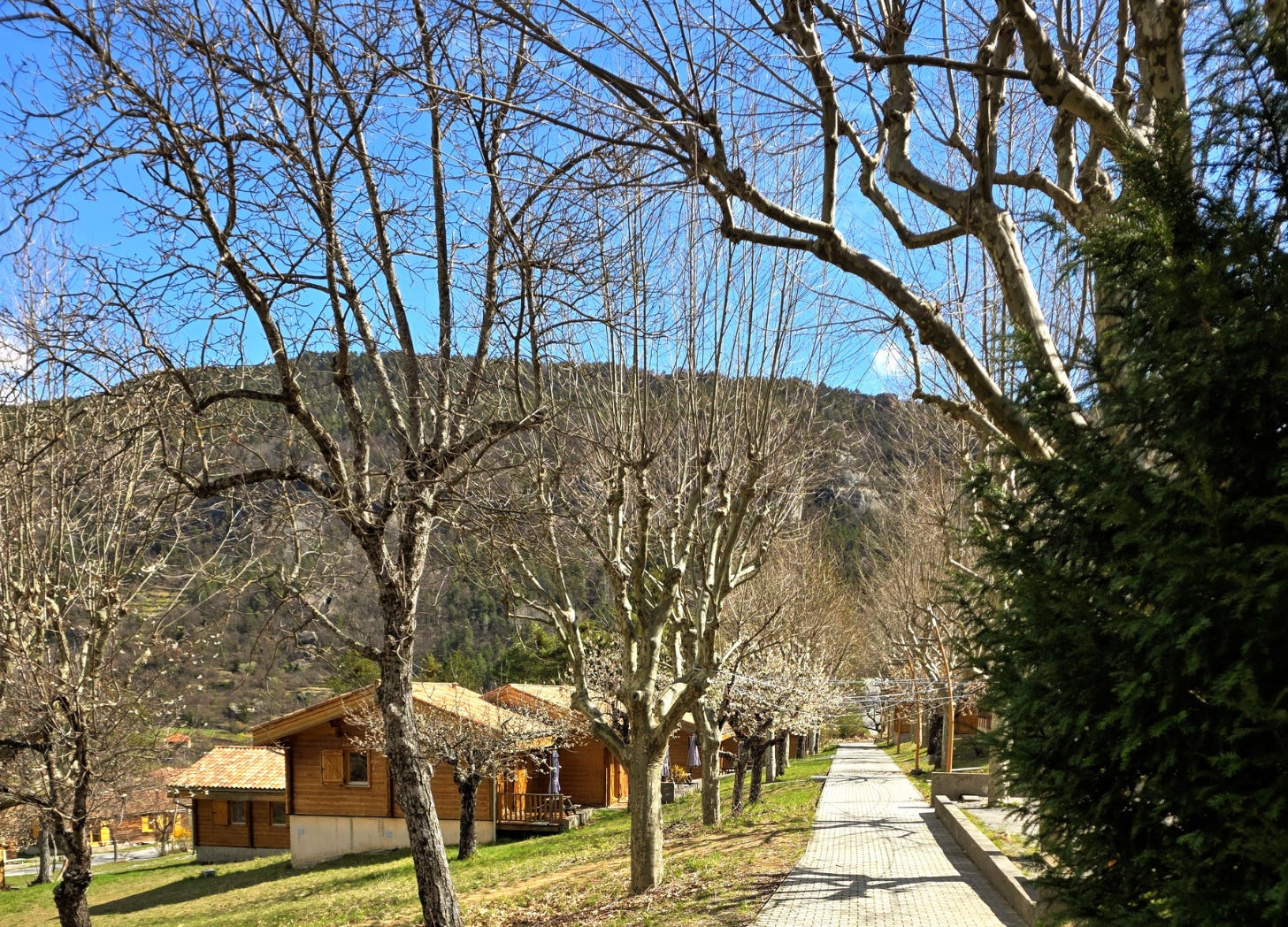
The restaurant was up a small road from the village, a 1930s building set against the hillside with chalets scattered through what had once been an orchard. From the terrace you could see the whole of Annot laid out below — the yellow mairie, the red roofs, the river threading between the houses. The chalets, I would learn, you could rent. I made a note.
The owner met us at the door. Le Pré Martin was hers and her husband Alain’s. She gave us a preview of what we would be eating, and then introduced us, one by one, to the people who had grown or raised or made every part of it.
The snails were from a lake. I had visited a snail farm near Thiers once, where the snails lived in a trailer over stacks of damp soil, and I’d been wondering ever since how lake-snails would be different. Two women from a chestnut farm in Braux called Le Cloterriou had brought chestnut cream for the dessert; they make their cream and natural chestnuts in the orchard, and they run a chambre d’hôtes there. I tucked that away. The trout farmer, who’d be sending out our second course, stood quietly to one side; I’d visited a sturgeon farm not long ago and had a sense of the work. And then there was a woman from the Annot butcher shop. The ravioli, the owner told us, were hers.
The food started coming. The snails first, then the trout, and then the two dishes that were new to me: the ravioli and the oreilles d’âne.
The ravioli were tiny. Maybe an inch square, the pasta sealed by hand and stuffed with daube — stewed beef pulled, seasoned, folded into the dough. The sauce was butter, just butter, hot enough to steam on the fork. Daube ravioli in this part of France are sometimes served with the daube’s own red-wine cooking juices, sometimes with tomato sauce, sometimes — like this — with plain butter.
The woman who’d made them was from De Vincenzi, the village butcher shop. I had asked her a few questions during the introduction. Hers was the fourth generation in the family to make these ravioli. The recipe had come down from the ones before — her mother, her grandmother, and the woman before that, whoever she was. I thought of my own grandmother. She had been Italian, and what she made was something else entirely, but the way of it — by hand, from memory, from her mother — was the same.
The oreilles d’âne — donkey ears — turned out not to be pasta at all. The dish is named for the wild spinach leaves that go into it, which when full-grown have the shape of a donkey’s ear. It is a gratin:
layers of lasagna sheets and spinach and béchamel, baked with grated tomme on top. I have been looking for the recipe ever since; I want to make it for Wine Wednesday at home with Kristen and Ben.
After lunch we walked down to the station and boarded the Train des Pignes — the “pine cone” train, narrow gauge, running from Annot back down to Nice. I do not get motion sickness on trains. I had eaten all of my lunch — ravioli, oreilles d’âne, the chestnut cream for dessert — and I sat by the window and kept the whole of it down, watching the chestnut groves slide past.
I made a list of what I would come back for. A chalet at Le Pré Martin, with the grès cliffs out the window. The chestnut farm at Braux, where the cream had come from. A hike up to the boulders. Lunch again at Le Pré Martin, with whichever sauce was on the ravioli that day. A trip to De Vincenzi, the village butcher, for the ravioli to take home — and a return at Christmas, when they trade the daube for squash. A morning at the lavoir.
DebraAll images are copyright of the author Debra Fioritto
Introducing Contributor, Debra Fioritto:
Visit her Contributor Page — Explore more of Debra’s work
MyFrenchLife™ – MaVieFrançaise® is a reader-supported publication. To receive new posts and support my work, consider becoming a free or paid subscriber.